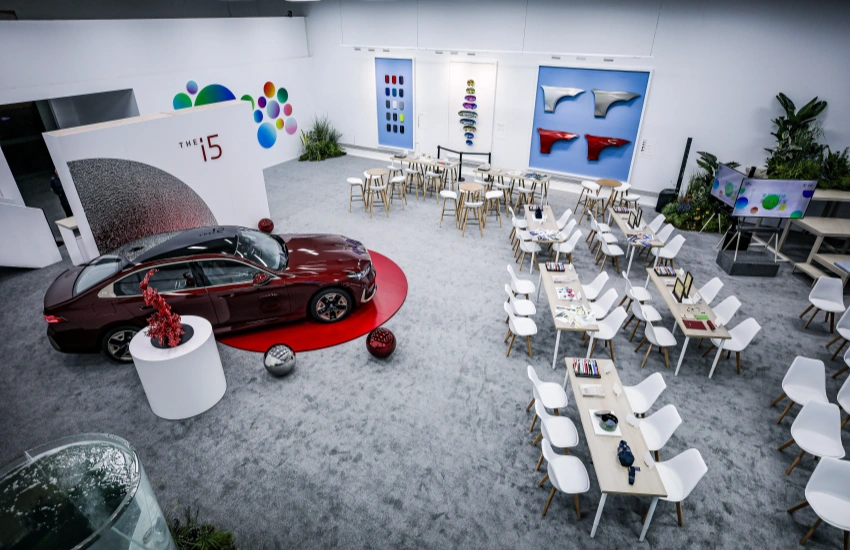
On July 18th, at the 4th BMW Group China Sustainable Development Summit, Mr. Jochen Goller, President and CEO of BMW Group Greater China, likened BMW's leadership in sustainable luxury to a race car driver's control over the track by focusing on distant targets: "Just as a race car driver steers towards distant target points to control the track, BMW always looks ahead to lead the sustainable luxury development trend."
Mr. Goller pointed out, "In the past, luxury often meant 'the best in the world,' but today, it signifies 'excellence in nature and virtue.' True luxury cannot exist without sustainability." He further emphasized, "As a premium brand, BMW considers sustainable development as an essential responsibility and mission. This not only means aligning with high quality but also achieving true sustainability through customer perception and experience."
The summit, themed "BMW Sustainable Trend Studio," focused on discussing automotive design CMF (Color/Material/Finishing) closely related to customers, showcasing BMW's long-term pursuit of sustainable luxury through aspects of color, materials, and craftsmanship. Experts from BMW's research, production, and aftersales services detailed how innovative thinking and methods are used to reduce environmental impact while creating greater value for customers.
Design innovation plays a crucial role in achieving sustainable luxury as approximately 80% of a product's environmental impact is determined during the design phase. Therefore, each BMW designer follows a "Design Brief" detailing the meticulous selection, testing, and on-board standards of BMW's chosen materials, ensuring both quality and environmental friendliness.
Currently, BMW is gradually increasing the use of recycled materials, including steel, aluminum, and raw materials from power batteries. In China, BMW has achieved closed-loop recycling of power batteries, reclaiming 1,041 tons of battery raw materials in 2023, enough to regenerate approximately 2,400 BMW i3 eDrive35L power batteries. Looking ahead, BMW's i Circular Concept Car has achieved the goal of 100% reuse and recyclability, even featuring a light gold body that requires no paint for ease of metal recycling.
BMW continues to develop high-quality innovative eco-materials such as "vegan" leather, bio-based materials, and natural fiber materials. For instance, the environmentally friendly Veganza material, free of animal-derived components, has been applied to the seating surfaces of the innovative all-electric BMW i5. The petroleum-free Verdana material has been used in the lower door panels and center consoles of the new generation BMW X Concept Car. BMW is also exploring the use of innovative materials in China, recently prototyping new material samples containing coffee grounds.
In today's automotive design landscape where digital technology plays a pivotal role, BMW polishes digital technology with unique craftsmanship to create a luxurious experience that is both sustainable and technologically advanced. Innovative all-electric models like the BMW i5 and i7 introduce a new integrated luminous grille, replacing traditional chrome-plated grilles and enhancing BMW's iconic 'kidney' design elements. Inside the car, the BMW Ambient Interaction Light Strip replaces traditional chrome trims, integrating touch-sensitive user interfaces, digital displays, and ambient lighting into a single strip to create richer spatial atmospheres through light and shadow.
Mr. Goller concluded, "Our commitment to customers remains unwavering, providing them with high quality, emotional pleasure, and pure driving enjoyment, while continuously refining our environmental responsibilities." He further noted, "Through sustainable design, we have set new standards for luxury: combining genuine quality, stylish beauty, and deep environmental care."