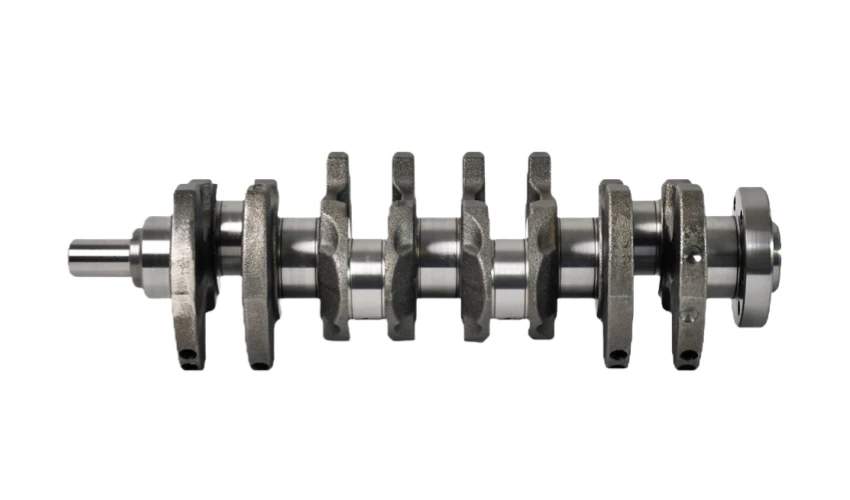
The crankshaft is a critical component of an internal combustion engine, converting the linear motion of the pistons into rotational motion to drive the vehicle's wheels. It plays a fundamental role in the engine's operation, directly impacting the vehicle's performance, fuel efficiency, and durability. Let's dive into the core aspects of crankshafts, covering their functions, types, materials, and common issues.
1. Crankshaft Function
The primary role of the crankshaft is to transform the up-and-down (reciprocating) motion of the pistons into rotational energy. This energy is then transmitted to the transmission system, which powers the wheels. The crankshaft connects to the pistons via connecting rods and is supported by main bearings within the engine block, allowing it to rotate smoothly.
As the pistons move downward due to the combustion of air-fuel mixture, the crankshaft rotates. This rotation continues in a cycle, enabling the engine to produce continuous power. The crankshaft also drives various ancillary systems in the engine, including the oil pump, alternator, and timing system.
2. Crankshaft Construction and Materials
Crankshafts are typically made from forged steel or cast iron, depending on the engine's requirements for strength and durability. High-performance engines, such as those in racing cars or heavy-duty vehicles, often use forged steel crankshafts because of their superior strength and resistance to fatigue. Cast iron crankshafts, on the other hand, are more common in everyday passenger vehicles due to their cost-effectiveness and adequate performance for lower power engines.
The main parts of a crankshaft include:
- Main Journals: These are the points where the crankshaft is supported by the engine block and rotate within the main bearings.
- Crankpins: These connect to the connecting rods and translate the pistons' linear motion into rotational motion.
- Counterweights: These are designed to balance the crankshaft's rotation and reduce vibrations caused by the piston movements.
3. Types of Crankshafts
Crankshafts can be classified into two main types based on their construction:
- Forged Crankshafts: Manufactured by forging steel under high pressure, these crankshafts are stronger, denser, and more durable. They are used in high-performance engines where greater loads are encountered.
- Cast Crankshafts: Produced by casting molten iron into a mold, these are lighter and less expensive but still capable of handling the demands of standard engines.
Crankshafts can also be categorized by their number of main bearings and crankpins, which is determined by the engine's configuration (inline, V-shaped, flat, etc.).
4. Crankshaft Balancing
Balancing a crankshaft is crucial to reducing engine vibration and wear. Crankshafts are inherently imbalanced due to the varying forces from each piston stroke, so counterweights are added to offset these forces. In high-performance engines, crankshafts are often fine-tuned to reduce vibrations that could cause engine damage or affect performance.
Dynamic balancing involves adjusting the counterweights, ensuring that the crankshaft spins smoothly at high RPMs. Any imbalance can lead to excessive vibrations, reducing engine lifespan and comfort.
5. Common Crankshaft Issues
Despite their strength, crankshafts can suffer from wear and damage, particularly in high-mileage engines or those subject to extreme conditions. Common issues include:
- Crankshaft Wear: Over time, the journals can wear down due to friction, leading to poor lubrication and potential engine failure.
- Crankshaft Cracking: This can occur due to high stresses, manufacturing defects, or inadequate lubrication, causing engine failure.
- Main Bearing Failure: When the bearings that support the crankshaft wear out, it can lead to misalignment or excessive friction, which may cause damage to the crankshaft itself.
- Out-of-Balance Crankshafts: Improper balancing can cause excessive vibrations, leading to accelerated wear of engine components and reduced performance.
6. Crankshaft Maintenance and Care
Maintaining the crankshaft primarily involves ensuring proper lubrication and monitoring for early signs of wear or damage. Regular oil changes and using high-quality engine oils can help extend the life of the crankshaft. It's also important to address any engine misfires, knocking, or unusual vibrations, as these may indicate crankshaft-related issues.
When rebuilding or overhauling an engine, the crankshaft should be carefully inspected for cracks, wear, or misalignment. Specialized equipment like micrometers and magnetic particle inspection (MPI) can be used to check for hidden defects that might not be visible to the naked eye.
7. Crankshaft Innovations and Future Trends
As engines become more efficient and powerful, crankshaft technology is also evolving. Modern crankshafts are designed with advanced materials like carbon composites to reduce weight while maintaining strength. Some manufacturers are experimenting with hybrid crankshaft designs that combine forged and cast components to optimize cost and performance.
Additionally, advancements in manufacturing techniques, such as 3D printing and laser-based forging, are enabling the production of crankshafts with complex geometries that were previously impossible to create. These innovations are set to further improve the efficiency, durability, and performance of automotive crankshafts.