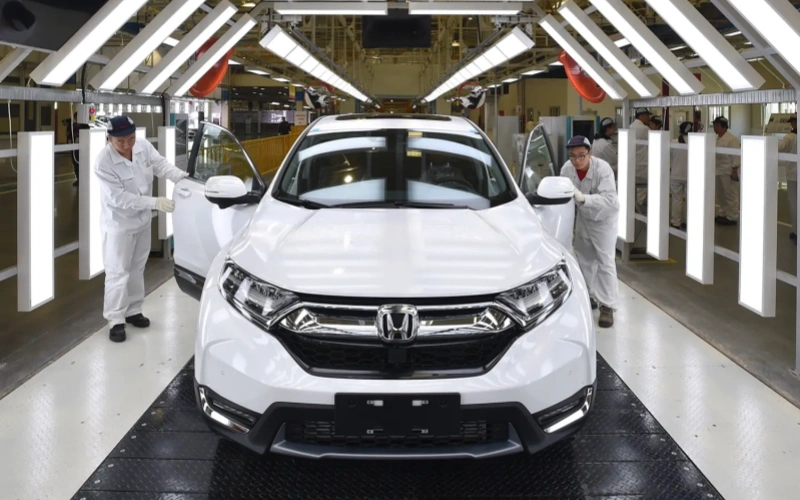
According to reports from Nikkei and Reuters, Japanese automakers Honda and Hino have recently announced significant adjustments in the Chinese market. Honda plans to reduce its gasoline vehicle production capacity in China, the world's largest automotive market, by 30%, resulting in a decrease from 1.49 million units to 1 million units annually. This reduction will involve factory closures and other measures, aiming to cut approximately 500,000 units, equivalent to 10% of its global production.
Honda has maintained production capacity in China surpassing that in the United States, making China its largest global manufacturing base. However, Honda's sales in China have sharply declined since 2020: 156.15 million units in 2021, down 4% year-on-year; 137.31 million units in 2022, down 12.1%; and 123.42 million units in 2023, down another 11%. In the first half of this year, Honda's sales in China have further dropped by 21.48%.
Regarding specific production adjustments, Honda plans initially to close or halt operations at two gasoline vehicle factories in China: the Guangzhou factory will close in October, and production at the Wuhan factory will cease from November. Additionally, another
Guangzhou factory is under consideration for closure or suspension. This move not only affects Honda but also follows Nissan's 10% reduction in Chinese production by closing a gasoline vehicle factory in Jiangsu and Toyota's partial shutdown of lines in Tianjin.
In the Chinese market, the government's encouragement of transitioning to electric vehicles and tax incentives has intensified competition in traditional gasoline vehicle sales. Due to insufficient product lines in electric vehicles, foreign carmakers like Honda with its new brand Xie and Toyota's BZ series are actively pursuing electrification strategies to adapt to market changes.
Furthermore, with the rapid expansion of China's new energy vehicle production capacity, expected to reach 36 million units by 2025, surplus production capacity is shifting towards Southeast Asia and South America. This trend has already influenced decisions on production by brands like Subaru in Thailand.
In summary, despite challenges, China remains crucial for Japanese automakers as the world's largest automotive market. They are adjusting production capacities and accelerating electrification strategies to manage market pressures and achieve sustainable business recovery.