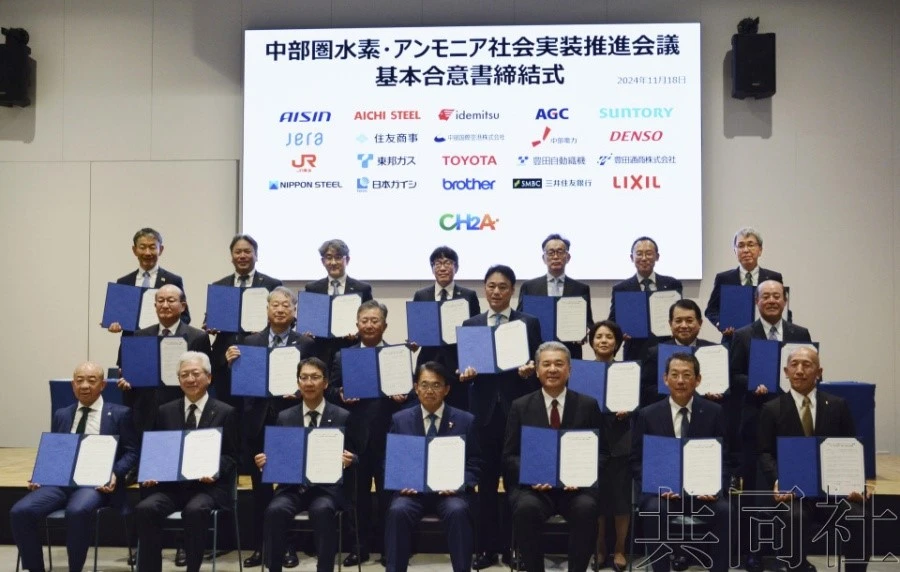
On November 18, Toyota Motor Corporation, Suntory Holdings, JERA, and 20 other companies signed a basic agreement with the Aichi Prefectural Government and other regional stakeholders under the "Chubu Region Hydrogen-Ammonia Society Implementation Promotion Conference." This collaboration aims to establish a sustainable hydrogen-ammonia society, focusing on creating supply chains and seeking governmental support to accelerate implementation.
The agreement represents a significant step toward building a hydrogen and ammonia supply infrastructure in Japan. Aichi Prefecture Governor Hideaki Omura, speaking at the signing ceremony in Nagoya, emphasized the importance of this initiative, stating, "Establishing supply chains for hydrogen and ammonia will drive industrial development and create jobs." He further called on the central government to consider the full-scale demand expected after 2030 and to quickly provide clear policies and support to enable the realization of these goals.
Toyota Executive Vice President Hiroki Nakajima also addressed the gathering, expressing the company's commitment to sustainable development. He remarked, "We hope to contribute to the creation of a sustainable society by promoting the use of hydrogen and ammonia." Toyota's involvement highlights its dedication to advancing next-generation energy solutions as part of its broader multi-pathway strategy to achieve carbon neutrality.
This collaboration signifies a milestone in Japan's journey toward a decarbonized society. By leveraging the expertise and resources of diverse industries, the initiative seeks to overcome challenges such as the high cost of hydrogen production and limited infrastructure. The basic agreement underscores the necessity of public-private partnerships in driving forward the hydrogen and ammonia economy, laying the foundation for a cleaner, more sustainable future.
As the world increasingly turns to green energy solutions, the Chubu region's efforts to build a hydrogen-ammonia society serve as a blueprint for other regions. This initiative not only aligns with Japan's national goals for energy transition but also demonstrates the potential of collaborative innovation to address global environmental challenges.