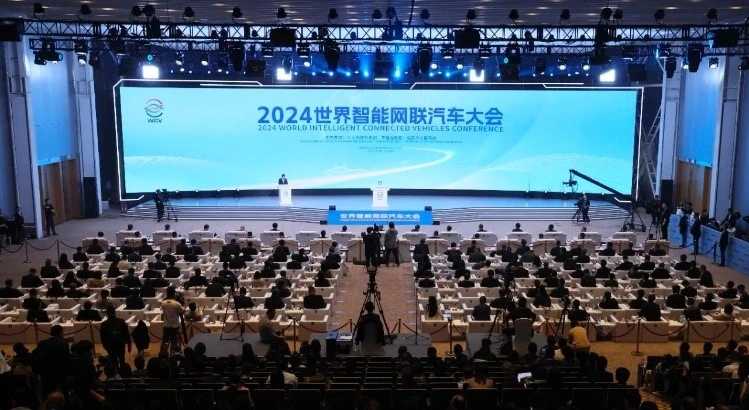
The 2024 World Intelligent Connected Vehicles Conference Held in Beijing: China Deepens International Cooperation and Promotes Industry Safety Development
In October 2024, Beijing hosted the 2024 World Intelligent Connected Vehicles (ICV) Conference, attracting numerous government authorities and leading international organizations from around the globe. A representative from the Ministry of Industry and Information Technology (MIIT) highlighted China's ongoing efforts to enhance international cooperation in the ICV sector and emphasized the importance of cybersecurity and data protection in the industry's future development.
According to the MIIT, in addition to China, countries such as the United States, the European Union, Japan, and South Korea have also released standards and strategies related to ICVs. While focusing on high-quality development of its domestic ICV industry, China is actively sharing opportunities and benefits with the world. In particular, China has spearheaded the formulation of over ten technical regulations, including electric vehicle safety and battery durability, and has been actively participating in the global automotive standards-setting process.
Expanding Global Partnerships: A New Chapter in International Cooperation for the ICV Industry
During the conference, the China Automotive Technology and Research Center Co., Ltd. (CATARC) emphasized its commitment to strengthening international collaboration. CATARC has already established China's first permanent international center for automotive standards in Switzerland and maintains close ties with government agencies, institutions, and industry organizations in over 30 countries. Additionally, CATARC has facilitated the establishment of joint laboratories for new energy and ICVs in Thailand and Malaysia, further promoting cooperation between Chinese and international automotive companies.
Gong Jinfeng, Deputy General Manager of CATARC, remarked, "We will continue to deepen collaboration with the international community to support the innovation and development of both Chinese and overseas companies in the ICV sector."
Global Leaders Praise China's ICV Development
The conference attracted numerous exhibitors from across the globe, significantly increasing its international profile. Industry leaders from Bosch, the Thailand Electric Vehicle Association, the Academy of Athens, Volkswagen, and others expressed high praise for China's achievements in the ICV field.
Bosch Chairman Stefan Hartung, visiting China for the fourth time, was impressed by Chinese consumers' growing demand for intelligent driving experiences. He noted, "85% of Chinese consumers are willing to use automated navigation driving features when purchasing vehicles. In the ICV sector, partnering with Chinese companies is essential to bring intelligent vehicles to market swiftly."
Similarly, Surot Saengsuneet, President of the Thailand Electric Vehicle Association, praised China's rapid progress in ICV technology, stating, "China's growth in ICV technology is exponential, and it is truly astounding."
George Giannopoulos, a member of the Academy of Athens, revealed that Athens currently operates 250 electric vehicles imported from China in its public transportation system, significantly reducing carbon emissions. He believes that China is one of the most important global players in the ICV field and will continue to lead the industry in the future.
Ralf Brandstätter, Executive Vice President of Volkswagen Group China, emphasized that Volkswagen is working to integrate China's ICV innovations with its engineering expertise to unlock further market opportunities. "The Chinese ICV market is full of innovation, and by combining it with Volkswagen's technical know-how, we are confident that many new opportunities will emerge," he said.
Safety First: The Key to ICV Industry Development
As ICV technology advances, cybersecurity and data protection have become core issues for the industry's future. A representative from MIIT stressed that as cars become more digital, intelligent, and interconnected, cyberattacks from the internet are increasingly targeting vehicle networks and physical systems. Network security, data safety, and functional safety risks are becoming intertwined. Enhancing overall automotive safety capabilities is crucial for the healthy development of the ICV industry.
Industry players are actively responding to these challenges. The China Automotive Engineering Research Institute (CAERI) has formulated the country's first dedicated evaluation procedure for network information security and has conducted preliminary testing on over 20 different vehicle models to identify potential cybersecurity and privacy risks. In Chongqing, Changan Automobile has established a consortium comprising manufacturers and users to conduct real-world road testing of ICVs to further improve safety.
He Peng, head of CAERI's Network and Data Security Laboratory, stated, "Through privacy security assessments, we can identify potential cybersecurity risks in ICVs, helping companies enhance privacy protection measures and providing consumers with reliable car selection guidance."
Looking Ahead: The ICV Industry Continues to Deepen Global Collaboration
The 2024 World ICV Conference served not only as a platform for technical exchange but also as a global stage for cooperation. China showcased its technological strength in the ICV sector and its openness to international collaboration. As more global partners join, China's ICV industry will continue to innovate, driving high-quality development in the global automotive sector.