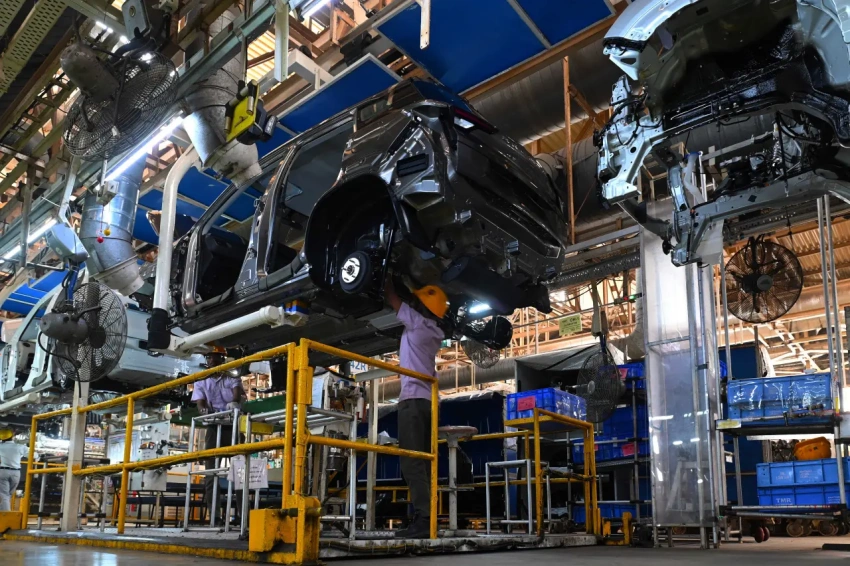
On February 25, 2025, Suzuki's Indian subsidiary, Maruti Suzuki, officially commenced production at its new factory in Kharkhoda, Haryana, located in northern India. This marks the completion of the first phase of the facility's construction. By 2028, the factory is expected to become one of the largest passenger car manufacturing bases in Asia. This is the first new factory opened by Maruti Suzuki in India since 2017, representing a significant step in Suzuki's accelerated expansion in the Indian market.
The new factory will eventually house four production units, each with an annual capacity of 250,000 units. The factory is expected to gradually scale up its capacity by 2028. The first model to roll off the new production line will be the compact SUV Brezza, which is currently produced at Maruti Suzuki's Manesar plant. With the new factory in operation, Maruti Suzuki is pushing forward with its expansion plan, aiming to increase its annual production capacity in India from 2.6 million units to 4 million units by 2030. Despite a slight slowdown in consumer spending, India's passenger vehicle market is expected to grow to 6 million units by 2030, reinforcing its position as the third-largest automotive market in the world.
Suzuki has laid out a mid-term strategy for 2030, including a substantial investment plan of ¥4 trillion (approximately $268 billion USD) targeted at expanding manufacturing infrastructure in India. However, in response to increasing global competition, Suzuki has adjusted its electric vehicle plans. The company has scaled back its original target of launching six all-electric vehicle models in India by 2030, now reducing the goal to four models, demonstrating a flexible approach to its electric transformation.
At the same time, Maruti Suzuki is facing intensified competition in the Indian market. Given the changing market conditions, Suzuki has decided to reassess its capacity expansion plans and adjust its approach based on market dynamics. The company stated that it would gradually move toward achieving its goal of 4 million units in annual production by 2030, when the time is right.
Despite the growing competitive pressures, Suzuki continues to view India as a key driver of global growth. In a recent report, the company emphasized that while customer demands for product features, equipment, and service quality are rising, the immense potential of the Indian market makes it a central pillar of Suzuki's future development. Overall, Suzuki's expansion momentum in India remains strong, and with the new factory now in operation and continued investments planned, Suzuki is well-positioned to maintain and strengthen its market share while actively responding to the global automotive industry's transformation toward electrification and smart technologies.