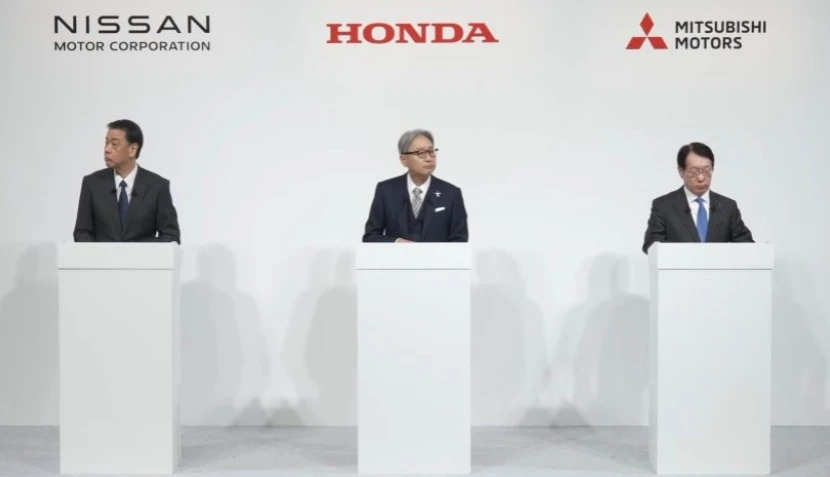
On December 23, Honda Motor Co. and Nissan Motor Co. officially announced the signing of a memorandum of understanding to begin merger negotiations. The two companies plan to establish a holding company through joint investments by August 2026, at which point their individual stocks will be delisted. This merger will create the world's third-largest automotive group, following Toyota and Volkswagen, marking a historic shift in Japan's automotive industry.
The core objective of this merger is to leverage economies of scale to enhance competitiveness, particularly in emerging technologies such as electric vehicles (EVs) and intelligent driving systems. Post-merger, the group will streamline operations by sharing production lines, purchasing components in bulk, and collaborating on R&D projects to improve overall efficiency and innovation capabilities. The U.S. market, a critical arena for both Honda and Nissan, is expected to see further strengthened competition. However, challenges exist regarding how to integrate overlapping models and resources. For example, Honda's Accord and Nissan's Altima, as well as Honda's CR-V and Nissan's Rogue, directly compete in the U.S. market. Deciding which models to keep and how to manage brand and product strategies will be a key issue for the merged company.
In addition to Honda and Nissan, Mitsubishi Motors is also considering joining the merger. Mitsubishi, which has a long-standing alliance with Nissan, is currently 24% owned by Nissan. Should Mitsubishi join, the combined group's annual sales are expected to exceed 8 million vehicles, making it the third-largest automotive group globally, only behind Toyota and Volkswagen. However, Mitsubishi's decision is still pending, with a final decision expected by the end of January 2024.
Despite the potential benefits, industry experts have raised concerns about the lack of strong technological synergies between Honda and Nissan, which could make the merger's true value uncertain. Akira Nagai, a professor at Waseda University in Japan, stated that the success of the merger hinges on whether Nissan can quickly recover its financial health. If Nissan cannot restore its profitability, it could become a burden for Honda. Additionally, the merger must address the challenges of integrating overlapping product lines and marketing teams, which could lead to inefficiencies.
Since the announcement of the merger, Nissan's stock has surged nearly 30% in five days, reflecting investors' optimism about the deal. However, there are concerns that the merger could lead to factory closures or job cuts, particularly in the U.S., where Honda operates 12 plants and Nissan operates 3. Both companies have stated that the merger is not aimed at significant layoffs or factory closures, but such actions cannot be ruled out.
The Japanese government has expressed support for the merger. Minister of Economy, Trade and Industry, Yasuhiro Muto, welcomed the merger as a way to foster innovation and enhance corporate value. With the rise of Chinese automakers, Japan's auto industry is facing increased pressure to maintain its competitive edge.
The merger is set against the backdrop of a rapidly changing global auto industry, driven by the transition to electric vehicles and smart technologies. As Chinese automakers continue to grow, Honda and Nissan will face even fiercer competition. Shirofumi Takeo, an analyst at the Itochu Research Institute, warned that despite the short-term benefits of merging, the rapid innovation by Chinese electric vehicle manufacturers could pose an even greater challenge to the Japanese duo.
For Honda and Nissan, this merger represents more than just a move to scale up; it is a strategic effort to strengthen their competitiveness in the face of a rapidly evolving global automotive landscape. While the path ahead is fraught with challenges, the merger holds the potential to position these two companies as significant players in the electric and smart vehicle markets. The future of the merger will depend on how effectively the two companies integrate their operations, address the challenges of overlapping product lines, and navigate the shifting regulatory landscape in key markets like the U.S. With more details expected in the coming months, this merger is set to reshape the global automotive industry.