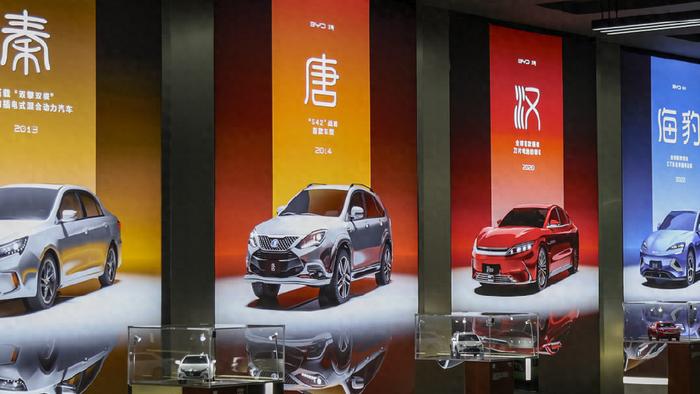
Following BYD's third-quarter financial report, which saw its quarterly revenue surpass that of Tesla for the first time, there has been renewed interest in comparing these two new energy vehicle giants. While both companies lead in the industry, BYD and Tesla showcase distinct differences in market strategies, product positioning, and production management, each reflecting a unique approach from China and the United States.
Market Strategy: Mass-Market Approach vs. Premium Brand Positioning
In recent years, BYD has employed a "flood-the-market" strategy in China by continuously expanding its product lineup and focusing on value-for-money, aiming to capture a larger market share. During the third quarter, BYD introduced a range of models, including the Qin L and Seal 06 DM-i, to meet the needs of various consumer groups at different price points. Furthermore, its Qin PLUS, Seagull, and Song PLUS models accounted for over 35% of sales in the third quarter, highlighting BYD's competitive edge in the mid- to lower-end markets through extensive market coverage and a cost-leadership strategy.
In contrast, Tesla focuses on strengthening its premium brand image and enhancing the intelligent driving experience on a global scale. Tesla's strategy involves maintaining its existing models and brand effect rather than frequently introducing new models, a "laid-back" approach that capitalizes on stable sales of current models. At the same time, it has shifted its R&D focus toward autonomous driving and other intelligent technologies, aiming to secure a unique advantage in the high-end market.
Cost and Production: The Toyota Model and BYD's Localization Strategy
BYD has drawn heavily from Toyota's "cost + efficiency" model for production management and implemented extensive vertical integration through its series of subsidiaries, such as Fudi. This approach has enabled BYD to achieve greater cost control and production efficiency, reflected in its third-quarter operating profit of RMB 14.4 billion and a record-high profit margin of 7.17%. BYD's cost leadership is particularly evident in its competitively priced models, setting a benchmark for value in the market. Additionally, its dual-model strategy effectively distributes R&D costs and expands room for price reductions, further strengthening its market competitiveness.
Tesla, on the other hand, continues to drive down production costs and improve efficiency through a highly automated production system and a globalized manufacturing network. Its cost-management approach is more globalized, leveraging multiple Gigafactories to benefit from economies of scale. However, Tesla's cost control is comparatively conservative and less vertically integrated than BYD's. Tesla relies on a streamlined supply chain and high automation in manufacturing, distinguishing its approach from BYD's direct integration into the production process.
Technology and Product Innovation: Enhancing Intelligence and Leading in NEV Transformation
As demand in the new energy vehicle market continues to evolve, BYD and Tesla's product and technological strategies diverge significantly. BYD's latest technologies, such as the new-gen pure electric E Platform 3.0 Evo and the fifth-generation DM-i, have lowered usage costs and increased energy efficiency, making BYD vehicles highly attractive to customers and expanding their appeal as a viable alternative to fuel-powered vehicles. These innovations give BYD a competitive edge in energy conservation, resonating with many consumers.
Tesla, in contrast, is focused on advancements in autonomous driving as a key differentiator. By leading in intelligent technology and self-driving, Tesla seeks to enhance the driving experience, reinforcing its high-end brand positioning. Despite a relatively streamlined product lineup, Tesla's dominance in smart technology provides it with a distinct market share and competitive advantage.
Future Outlook: A Multi-Level Global Competition
Looking ahead, the competition between BYD and Tesla in the new energy vehicle market will extend beyond product and pricing, encompassing brand identity, technology, and global expansion. BYD's accelerated international expansion positions it as a proactive player in emerging markets, continuously optimizing technology and costs. Tesla, meanwhile, leverages its global brand recognition and advances in autonomous driving to maintain strong competitiveness in key markets. The ongoing rivalry, built on contrasting growth paths, is expected to invigorate the global new energy vehicle industry.