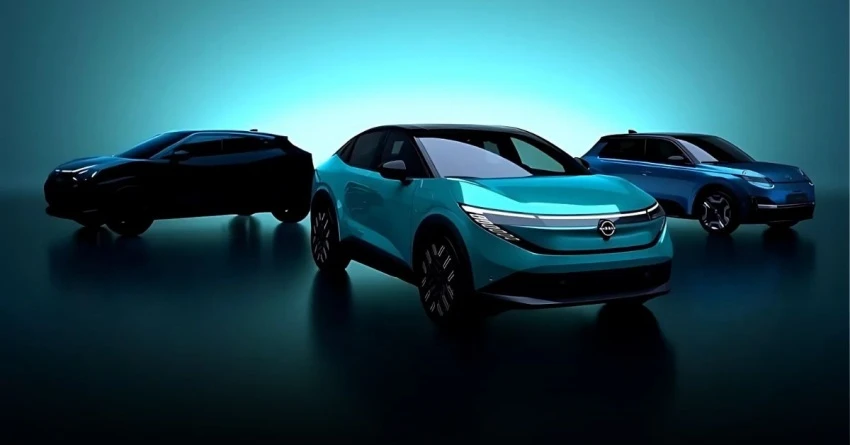
[June 2025] - Nissan is set to officially unveil the third-generation LEAF later this month. As the successor to the world's first mass-produced electric vehicle, the new LEAF has garnered significant anticipation. The latest model not only features a bold redesign, but also introduces comprehensive upgrades in core technology, driving range, and user experience-underscoring Nissan's continued leadership in the EV segment.
Visually, the third-generation LEAF marks a departure from the hatchback styling of its predecessors, embracing a sleek crossover SUV silhouette that aligns with current market preferences. The front fascia adopts Nissan's latest family design language, bearing similarities to the Qashqai, while distinguishing itself with EV-specific elements such as a closed-off grille, a full-width LED daytime running light, and an illuminated Nissan badge-accentuating its electric identity. The body features flowing lines inspired by the fastback styling of the larger Ariya, paired with a floating black roof that adds a youthful, dynamic edge.
Attention to detail is evident throughout. The new LEAF incorporates flush-mounted door handles for improved aerodynamics, and its 19-inch alloy wheels draw design cues from the top-tier Pathfinder, offering a strong visual presence. While official rear photos have yet to be released, heavily camouflaged prototypes suggest a liftback-style tailgate with a wide opening for enhanced practicality.
Built on the CMF-EV platform shared with the Ariya, the new LEAF benefits from a flat-floor architecture and a roomier cabin. Power is delivered via a single front-mounted motor producing up to 220 horsepower and 354 Nm of torque. The redesigned front drive unit is 10% smaller than the previous generation while maintaining output, offering improved packaging efficiency. Notably, the rear suspension has been upgraded from a torsion beam to an independent multi-link setup, promising a smoother, more composed ride.
The most significant technical leap lies in battery thermal management. Unlike its predecessors, which relied on passive air-cooling, the new LEAF features a liquid-cooled battery system that precisely regulates cell temperatures to optimize performance, durability, and safety. Additionally, a heat recovery function captures excess heat from the charging port to precondition the battery in cold weather-boosting range and charging efficiency in low-temperature conditions.
Range figures vary depending on configuration. Nissan states that the new LEAF will offer multiple battery options, with full-charge ranges between 186 and 311 miles (300 to 500 kilometers). In fast-charging scenarios, the vehicle can gain up to 155 miles (250 kilometers) in just 14 minutes, or approximately 124 miles (200 kilometers) in 40 minutes-greatly enhancing charging convenience for long-distance travel.
Aerodynamically, the vehicle achieves a new benchmark for Nissan EVs, with a drag coefficient as low as 0.25 for the European variant, and 0.26 for U.S. and Japanese versions. The difference stems from regional variations in wheel and mirror design. A standout feature is the optional electronic panoramic sunroof, which uses electrochromic glass and infrared-reflective coatings to adjust light levels without the need for a physical sunshade-adding to cabin comfort and visual sophistication.
While the interior has yet to be revealed, it is expected to adopt a more minimalist and tech-forward approach, moving away from the conventional fuel-vehicle-inspired designs of previous generations. Users can anticipate a cabin layout that aligns with modern EV standards and offers enhanced digital integration.
According to Richard Candler, Nissan's Global Vice President of Product Strategy, the third-generation LEAF is designed to appeal to drivers transitioning from internal combustion vehicles. The goal is to combine aerodynamic styling with everyday practicality and long-range usability. The targeted range is between 300 and 500 kilometers (186 to 311 miles), with full support for rapid charging via NACS-standard connectors.
Since its launch in 2010, the LEAF has sold nearly 700,000 units worldwide, solidifying its legacy as a pioneer in electric mobility. In developing the new model, Nissan has drawn extensively on user feedback to ensure the LEAF remains competitive in today's fast-evolving EV landscape. As the market gears up for intensified competition in 2025, the all-new LEAF represents both a continuation of a historic legacy and a bold step into the future of electric driving.