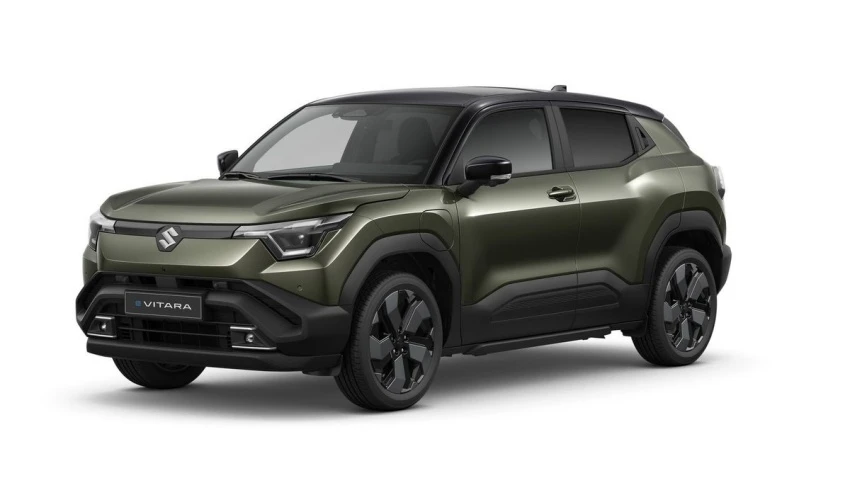
On August 26, Suzuki Motor Corporation officially began exports of its first battery electric vehicle (BEV), the e VITARA, from its plant in Gujarat, western India. The milestone marks Suzuki's entry into the global EV market with India positioned as a key production and export hub.
The e VITARA, a mid-size SUV developed as a global strategic model, will be exported to more than 100 countries and regions, including Japan and Europe. With a driving range exceeding 500 kilometers on a single charge, the model is built on the newly developed HEARTECT-e platform and features the ALLGRIP-e electric four-wheel-drive system, combining dynamic performance with Suzuki's signature SUV versatility.
Suzuki President Toshihiro Suzuki attended the shipment ceremony alongside Indian Prime Minister Narendra Modi, Gujarat Chief Minister Bhupendra Patel, and Japan's Ambassador to India, Hiroshi Suzuki. "It is a great honor to hold this launch event with Prime Minister Modi present," said Suzuki. "The e VITARA will be produced at our Gujarat plant and exported to over 100 countries worldwide. Together with our hybrid models, which use locally produced lithium-ion batteries, Suzuki will continue to contribute to the vision of 'Make in India.'"
Prime Minister Modi praised the development, stating: "From now on, vehicles used across the world will carry the 'Made in India' label. This is another big step toward our goal of positioning India as a global manufacturing hub."
The Gujarat plant, operated by Maruti Suzuki, is expected to play a central role in Suzuki's global electrification strategy. The facility has an annual production capacity of 1 million vehicles and will serve as the company's first international base for EV manufacturing. Alongside vehicle production, Suzuki, Toshiba, and Denso are jointly operating a lithium-ion battery factory nearby, which has now begun local electrode production to further strengthen supply chain resilience.
India has become Suzuki's largest market, accounting for more than half of its global sales. However, the company has faced challenges recently, with April–June sales falling 6% year-on-year to 402,000 units - the first quarterly decline in five years. By accelerating its EV rollout and boosting exports, Suzuki aims to balance its reliance on the Indian domestic market and reinforce its competitiveness in global markets.
Suzuki is also steadily expanding capacity in India. Earlier this year, a new plant in Haryana commenced operations, raising the company's total production capacity in the country to 2.6 million units annually. The automaker plans to increase this figure to 4 million units by 2030, underscoring its long-term commitment to the Indian market.
The launch of the e VITARA highlights not only Suzuki's strategic shift toward electrification but also India's growing importance as a global EV production hub. With government support and rising investment, India is positioning itself at the forefront of the transition to sustainable mobility, and Suzuki's latest move signals confidence in both the market and the country's manufacturing capabilities.